Monday, July 16, 2012

Math Musings, Part Deux


It has been way too long since I last posted! I have had MANY new ideas over the last (almost) year, and have had just too little time to write about it. Now that it is summer, I am hoping to renew my commitment to blogging about assistive tech and special ed.

During the last school year, I began teaching specialized math to 6th, 7th and 8th grade students in a pull out setting. It was truly an eye opening experience, and I have learned so much from my students. Now, as summer is in full swing, and I am beginning to think about my classes for next fall, I am wondering about how to best teach math to students who struggle to understand and retain concepts due to the nature of their learning differences.

Current Mathematical Methods:
Our current curriculum frameworks in Massachusetts are divided into 5 areas of concentration: Ratios and Proportions, The Number System, Expressions and Equations, Geometry and Statistics and Probability. At each middle school level, students explore and learn material from each strand, every year.

So, the question I have been asking is... is this the best way to teach math to special education students? Is it better to have student learn a "smattering" of each topic area, each year? Most of my students have difficulty with acquiring and retaining mathematical concepts. I can teach them fractions this year, and by next year's fraction unit, they have difficulty accessing previously learned concepts, even with frequent review/spiraling.

My Big Question:
This of course led me to wonder whether there is a better way to teach math to this population of learners. What if we teach each strand in depth? What if I spend more time teaching fewer strands each year, but teach them in depth? For example, what if I teach number systems to my 6th grade class, but continue to teach them 7th and even 8th grade topics after they have mastered 6th grade material. Keeping brain development in mind, what if I hold off teaching more difficult concepts, such as linear expression, proportions and ratios until 8th grade, but teach them the 6th, 7th and 8th grade material sequentially in one year? If I do this, my students will have been exposed to ALL strands for each middle school topics by the end of 8th grade, just not according to the flow of the state frameworks. Doing this, I think that students would have the opportunity to see how math knowledge is sequential, and how it builds upon previously learned concepts. I am not so sure that they make this connection in our current "a little bit of this, a little bit of that" math process.

Ahhh, yes, the down side...of course this would be reflected in our MCAS scores, as 6th grade students would not have learned all 6th grade content material, etc... However, they will have learned concepts above grade level in other areas. But my mind keeps spinning back to my question: would this approach help my struggling math students?

So What Now?
I have been asking both seasoned special educators and math teachers this question. The answer I get from most of them is surprising. They like this crazy idea of teaching fewer units each year, teaching them in depth, across grade levels. One math teacher told me that she agrees that the current flow of curriculum is fine for typical learners, but that my crazy idea might just be a better way to approach teaching math to students with learning differences. Now if only I can figure out a way to try this in the classroom.

Please feel free to leave me your opinion on this! I am interested in hearing all points of view, ideas and feedback.


Thursday, July 28, 2011

Dyslexie - A new tool for the accessibility toolbox

The other night, during the 2 1/2 hour rain delay at Fenway Park, my niece and I chatted about twitter, blogging and other forms of information transfer. She mentioned that she had heard heard of a "new weighted font" that was developed to help those with dyslexia. Needless to say, I was intrigued with the idea of improving print accessibility for people with print disabilities.   


Dyslexia

Dyslexia is a life long condition that impacts literacy. It often runs in families, and is prevalent in approximately 10-15% of the population. It often goes undiagnosed. People with dyslexia tend to think non-verbally; they think in pictures rather than in words. This tends to be a problem in our text-driven society.


Enter Christian Boer and Studiostudio. Boer created Dyslexie not as a cure for dyslexia, but as a tool to help make type more readable. As a dyslectic himself, he reasoned that since dyslectics think visually and respond well to graphics, why not develop a new typeface that was more three dimensional than existing fonts?


Let Gravity Prevail

Boer found that adding "weight" to the bottom of characters anchored them to the baseline, and enabled struggling readers to identify and discriminate between visually similar letters (such as b and d or b and p).  Just like gravity pulls mass toward the center of the earth, the weighted portion of the letter is pulled down to the baseline.  Other typeset modifications include an increase in the ascending or descending lines on some letters, and tipping others from their north pole-south pole alignment. People with print disabilities made fewer word errors and miscues when reading text in Dyslexie typeface.


The Final Word
As of now, Dyslexie is not available as free-ware, and is currently priced at 700 Euros, or approximately $1,000.

Saturday, July 23, 2011

Math Musings

Ok, my post today was supposed to be about using 3D technology in the classroom, but I was distracted by something my sister and I were discussing this morning. My sister is a middle school math/science teacher and for some unfathomable reason, we began talking about math fluency in middle school.  We chatted about the merits of informally assessing math skills in order to redress weaknesses and capture quantifiable data for progress reports. We agreed that just as reading fluency impacts a student's ability to comprehend text, math fluency impacts a student's ability to comprehend the language of numbers. Both areas require a solid base upon which to build more advanced concepts.

I remarked that there are several informal assessments to track fluency and comprehension for reading, but there appeared to be a dearth of informal resources to assess math fluency. Why is this? Is it that reading fluency is more important than math fluency? We have a QRI, why not a QMI?

I hung up with my sis, and being the technophile that I am, I began searching the web for informal math assessments for middle school and high school students. I trolled the internet for 3 hours...and came up with next to nothing. I found many informal inventories for grades K- 6, and only one honorable mention for grades K - 8 (Scholastic Math Inventory by Tom Snyder ). Nothing for grades 6-12. Back to square one.

I did find a few math related gems on the web today, so my searching wasn't a total loss.
UEN 7-12 Student Interactives is a free website developed by the Utah Education Network for students grades 7-12. The UEN site has links to math, science, ELA, social studies, lesson plans, video resources, worksheets and more. The math practice for upper level math students includes activities for algebra, geometry, data/probability, number sense and money skills. Each topic area has a variety of activities that are attractive, interactive and engaging. What I like about this website is that each activity displays and has links to the necessary video drivers to run effectively. Take some time to explore this website, it is well worth it! The activities for Geometry and Data/Probability are detailed below. Click on the picture to link to the math activities.


My second find was the MathStar website, created by the Los Angeles County Office for Education. This site has interactive activities for students, lesson plans and resources for teachers, worksheets, and discussions. The site did have a few broken links, but overall it is a great resource for middle school math teachers and students.


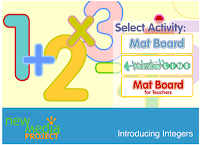
Try the Mat Board Activity:


My next blog will cover 3D technology and its educational applications. Enjoy!

Thursday, July 14, 2011

Welcome!

This is my inaugural post for my new blog, AsTek Talk, a coffeehouse forum to share and discuss technology that allows people with learning, cognitive and physical differences to access the world around them. I am a technophile at heart, but this blog will not be limited only to high tech educational ideas and solutions, but to low tech as well. So please feel free to add to the discussion. I welcome your thoughts and opinions!

On to the blog...

As a special educator, I am always looking for new and exciting things that will help my students access the curriculum in school AND at home. For high incidence special learners, specialized technology truly does level the educational playing field. Specialized technology does not have to be expensive, and in the case of one of my favorite suite of applications, is it free.

RSC, the Regional Support Center Scotland North and East has a phenomenal group of people who have designed and developed free downloadable software to benefit people with learning differences. Every time I check their website, I am amazed to see that they have added new and improved applications that are flexible, customizable and portable. All applications are designed to run from a flash drive as well as a hard drive. Students can customize their applications and run them anywhere, from any computer that supports a usb drive. What makes this so exciting in my opinion (other than that these wonderful downloads are free), is that they can be used at school and at home.

MyStudyBar has literacy supports that enable users to access content using their computer. It includes mind mapping, calendars, sticky notes, customizable background and text color, text masking, word prediction, talking dictionary, text to speech, a screen magnifier, NVDA screen reader, and voice recognition.


Next is MyVisBar, a suite of apps that offers support to learners with visual difficulties. It includes a screen magnifier, text masking, a screen reader and more.


Finally, a most exciting addition, Create&Convert which allows educators (and others!) to create/translate electronic documents into an accessible alternative format, such as audio or a talking book. This powerful (and free) application is a technology similar to more expensive document readers AND converts text to braille.


Enjoy, and please feel free to comment!
Tweet